Showing posts with label sabbath. Show all posts

Thursday, August 29, 2019

Delighting in God


Delighting in God
by Troy Cady

Moments of joy are the bookmarks of the soul. Like folds on the corners of the pages of your life, moments of joy are wrinkles that point you to something good. Turn to a joyful page mentally and you could swear you were there again physically. Despite some hard things I’ve experienced over the years, I am grateful that if you were to pick up the unfinished story of my life, you would see many, many page corners turned over—reminders that life has truly been filled with joys too many to count, unforgettable moments of delight, grace and wonder.
I think of childhood winters in Minnesota, playing hockey on an outdoor rink with friends from the neighborhood. In my memory, I can smell the wood burning in the stove-fire from the warming house, I can feel the heat and hear the laughter after my oldest brother told one of his many jokes.
I wonder: as you reflect on your own story…what pages are earmarked—what special moments of pure joy would we encounter there? I invite you now to enjoy a bit of silence as you turn in your mind’s eye to one of these pages.
I am convinced we can never have enough of such goodness. So, in this essay I invite us to look more deeply at the theme of delight. In another essay, I considered an aspect of delight that we don’t often think about: it’s the reality that God delights. Zephaniah 3:17 says that God delights in us and sings over us. Quite simply, I put it this way: God is not a killjoy; he loves us so much he actually likes us, enjoys us.
I write this in hopes that we will get caught up in God’s goodness to the point where we can reflect God’s delight and wonder in our own lives. To that end, in this teaching I want to explore 1) why delight matters, 2) what it is and 3) a few ways we are invited to live in delight.  

Why delight matters
First, why does this topic matter? To be honest, talking about living a delightful life seems like a luxury to us. I mean…who has time to talk about enjoying life when there’s so much work to be done, wrongs to be righted, and improvements to be made? Ultimately, this is why this topic matters. As a society, we are constantly driven to accomplish more and we feel guilt or shame if we don’t.  Sadly, this is an indicator to me that we tend to take ourselves too seriously.
To be sure, this mindset of crippling seriousness easily infects us. We live in a world where bad news dominates the daily media cycle and Facebook turns others into faceless abstractions such that we would do better to call it Hatebook. It’s easy to take ourselves too seriously when we are overwhelmed by negativity, fear and anger. This causes us to suffer from what author Christine Aroney-Sine describes as “play deprivation, nature deficit disorder, awe depletion, compassion fatigue, imagination suppression, and more.”[1] And, if it is true that God is, in his very essence, filled with delight, joy, and creativity, then it is also true that, as Aroney-Sine asserts, “…we suffer from God deprivation too.”[2]
Our need for delight is not a new concept. In the thirteenth century, Thomas Aquinas asserted that delight matters because it is essential for happiness—and happiness, he says, is “the last end [or goal] of human life.”[3]
In commenting on this, Peter Kreeft, a philosopher at Boston College, says that happiness is the ultimate goal in life “because all seek it as an end [in itself], not as a means to any further end...No one seeks happiness,” he says, “in order to be rich, or powerful, or wise, but people seek riches, or power, or wisdom because they think these will make them happy...”[4]
That’s why Aquinas devotes four large sections of his magnum opus, the Summa Theologica, to the matter of happiness. In one article, he provides four reasons as to why he thinks delight is essential for happiness.[5] 1) Delight, he says, is “a preamble and preparation” for happiness. Just as one needs instruction if one is to understand science, so delight is a teacher who prepares us for the eternal art of happiness. 2) Delight, he says, perfects happiness. It is like the soul of the body. If happiness is the objective state of total well-being, delight is the subjective experience of it. Delight perfects happiness because, through delight, we know first-hand that we are happy. 3) Delight, he says, is a helper to happiness, like a friend helping another friend achieve what could not be done alone. When we feel lost and lonely, delight is a wise companion showing us the way to happiness. And, 4) Aquinas observes that delight is essential for happiness because it is “attendant” to happiness, like heat is attendant to fire.

The nature of delight
Aquinas’ fourth observation does more than tell us why delight is important; it also tells us about the nature of delight. The mystery of being human is that no person you ever meet is only a mind, or emotion or a body. To be fully human (and gladly so) is to integrate mind, emotion and body—just as it is in the nature of a flame to always integrate heat, light and the substance (or body) of fire. To blaze with life, humans integrate (as Peter Kreeft puts it) “the light of the fire of life” and “the heat of the fire of life”[6]—while the fire itself is given tangible expression through our bodies.
Delight integrates these life-fire qualities of light, heat and substance. We experience it often as warmed affections or quickened emotions, but we also experience it when our intellect has been enlightened and we learn something new. What’s more, our mind and heart converge in delight such that we can actually sense it physically in our bodies—and sometimes this works the other way around, too. Our body has the capacity to tell us when our mind relishes an exciting new discovery or when our feelings are telling us we are falling in love. The taste of sweet fruit, or the sound of ocean waves or the tenderness and passion of sex all testify to the way delight unifies body, mind and heart. Just as it is impossible to pick apart the light, heat and substance of a flame, so it is impossible to separate what makes us wonderfully and mysteriously human. 
Because of this, I find it helpful to think of delight as the soul of life itself. And the expression “Bless the Lord, O my soul” (Ps. 103:1) illustrates this vividly. We often relate this expression to “the spiritual life,” imagining the words “bless” and “soul” as invisible realities. But the expression “bless the Lord, O my soul” points us to the body from first to last because the word “bless” here is the Hebrew word “baruch” or “barak”, meaning “to kneel.” And the word “soul” is “nephesh”—which means “neck.”[7] Significantly, the neck is the crossroads where blood, oxygen and the electrical signals of the nervous system pass through to integrate the mind, heart, lungs, and extremities in one glorious living, breathing, pulsing, walking, and reaching wonder.
Thus, “Bless the Lord, O my soul” could be rendered expansively as: “Bend the knee to the Lord, O my everything. Neck, do your work. Let my mind be rapt in wonder, let my heart (my emotion) be amazed and enjoy how good God is…and let my body show it: let me laugh and sing, shout, cry, run, rest and rise. Let worship sink deep into my bones; drive me to my knees because God is awesome and wonderful and beyond understanding. Make me a put-together person.”
The expression denotes wholeness, which the Bible describes as “shalom”—total well-being. It’s a vision of human flourishing and, indeed, the flourishing of all living things. In Psalm 72, we get a vivid picture of this “blessed” life of shalom. The Psalm was written by King Solomon during a time of peace and prosperity. Food was never lacking and the nation’s intellectual endeavors gained international recognition. It was a golden age. Though this psalm serves as a picture of Israel during the time of Solomon, it can also be taken as a description of what happens when people and the world are whole (or put-together) by delighting in God.
The Psalm says a world of shalom is a world where justice is done, the oppressed are defended, and children are fed. It says we are rescued from violence and the land is fruitful. As the psalmist finishes painting this picture for us, he observes in verse seventeen: “Then all nations will be blessed through him [the king], and they will call him blessed.”
Our picture of the happy life is enriched here because the word blessed appears in two different forms: “barak” and “asher.” Both can be translated as “blessed” but the former means “to kneel” while the latter connotes “gladness and happiness,” or “to make glad” or “to be happy.”
The first instance this word appears in the Bible is when Jacob’s wife Leah has a child and names him Asher. Upon his birth, she exclaims how happy she is and that others will call her happy, too, so she is going to call the child “Happy” or “Asher.” In Leah’s story, happiness is both an objective state of being and a subjective experience, both a noun and a verb.
That is the picture we get in Psalm 72 and it’s actually an image of a king kneeling to serve, such that the nations are blessed and the king is “happy” because the nations are blessed.
Princeton scholar Ellen Charry refers to this all-encompassing vision of shalom as asherism. It sounds like a strange concept, but Charry sums it up simply: “God enjoys our happiness and we enjoy God’s happiness.”[8] Asherism holds forth the hope that one day we will experience happiness not as a momentary experience but as a permanent, lasting reality—as it is in God’s very self. It affirms that God made all things out of God’s own deep gladness and joy—and God made humans in God’s image to reflect and experience that same gladness and joy. God wants all that is in God’s being and all that proceeds from God’s being to return to God, to flow in and out continuously in eternal gladness, like an endless ocean of deep, enduring happiness.

Ways to practice delight
In her book God and the Art of Happiness Ellen Charry includes several practical outcomes of asherism and I will mention two before considering other ways to practice delight as a means to happiness.
First, Charry asserts that to grow “in the art of happiness” it’s good to steward our talents and strengths well.[9] God, in utter gladness, has made each of us unique and it delights God when we notice, appreciate and live in step with the special abilities he has given us. Charry encourages us to be “unashamed” of our gifts, so if someone shares with you how you have blessed them, you can just say thank you to them and to God for making you the way he did. Just delight!
A second way Charry encourages us to practice delight is to enjoy creation by stewarding it well.[10] For those who are especially dedicated to creation care, it is good to remember to just enjoy creation along the way and to let yourself be amazed by nature’s ability to heal itself. In our work to save the planet we can sometimes feel overwhelmed. In those instances, you might like to try imagining God right by our side, smiling, sweaty and singing as he tends the fields and forests, rivers and lakes. He notices the butterflies and bees before we do, so it’s good to let God’s own sustenance of creation delight us deeply.
In any case, whether we are stewarding our gifts or stewarding creation, both types of stewardship are rooted in a key aspect of delight—which is noticing what God notices by bringing all your senses, your full self, to your waking hours. I think of the delight of cooking and relishing the taste of food that has been lovingly prepared. Just the act of slowing down to savor a meal can do wonders to strengthen your posture towards delight. I think of the wonder of music, the sounds of the wind, crickets and birds; we have endless opportunities to delight in God with our ears. I think of the many delights we can enjoy as we slow down to notice the scent of a recent rainfall or a plot of flowers, the smell of a puppy or fresh-ground coffee. Our eyes can delight as we slowly take in a painting of thick oil textures, a black-and-white photograph, or the veins and colors of a maple leaf. Gazing at the clouds, looking at the waves, or taking in the sunset can fill us with awe and wonder. Feeling the sand beneath your feet, gently touching a baby’s cheek, or just enjoying the feeling of water flowing freely through your hands can be great ways to delight in God. There is no contradiction between a godly life and a sensual life.
A key aspect of delight simply involves slowing down enough to be fully present. The older I get the more I am convinced this is the hardest thing for us to do. In a culture that values the self-made individual, there is little that makes us feel stranger than the experience of doing nothing. As soon as we have nothing to do, we fill it with something else to do.
In his book Theology of Play, Jürgen Moltmann observes how severely our desire for productivity impinges on our quest for happiness. He notes that, for most people, even vacation has become a phenomenon that must be put to useful ends.[11] Sadly, we often place unhelpful expectations on our rest, measuring it by how effective or fun or productive it was. Somehow, vacation itself even becomes work. Is it any wonder that, irony of ironies, the leisure sector is considered an industry? When rest becomes a market, something is seriously wrong. 
The Bible commends to us the practice of Sabbath to help us detox from our addiction to doing and productivity. In Hebrew it is the word “shabbat” and it literally means “stop, rest.”[12] The first instance of the word in Scripture is used in reference to God. It comes right after Genesis 1 where we have a picture of God creating the entire world out of sheer delight. Along the way, the story tells us that God noticed what he had made and blessed it. But then day 7 arrives and the text surprises us. Instead of continuing to make more wonderful things, God stops (“sabbaths”) and rests, truly rests. He just does nothing and he just enjoys being with what he has made.
Lest we think this anticlimactic, the writer gives us a clue as to why this “work of rest” is the pinnacle of all God’s works. The writer says that God not only “blessed” the seventh day, but it says he “got married to it.” Most translations render the Hebrew as “called it holy” but the Jewish scholar Abraham Joshua Heschel points out that the phrase “sanctified it” or “called it holy” connotes images of “betrothal” and “marriage.”[13] In other words, God loved this seventh day of rest so much that he said, “I want to marry you; I will cleave to your side forever and love you passionately.”
This is why the rabbinic community has historically referred to the seventh day as Queen Sabbath, because on the seventh day God, the King, took to himself a Queen—the nobility, the dignity, delight and wonder…of rest.
A teacher I had recently told a story about an experience he had with his grandson that illustrates how wonderful pure, simple rest can be. He was visiting his family in Central America and they were at a small, local grocery store. His grandson, who was about three, said: “Grandpa! Come here!” The boy led his grandpa to the back of the store where there was a pastry counter. He wanted the largest chocolate donut you have ever seen, so…Grandpa bought it. By the time they left the store, the boy’s face and shirt front were covered in chocolate frosting but he still had a lot of donut to eat. As they walked towards home, the boy kept eating his donut but they had to be careful because the sidewalk was very narrow and there were cars whizzing by on a narrow street to their left with a high wall towering up on their right. At a certain point, the wall lowered, so the boy could sit down on it just to keep enjoying his donut. Grandpa noticed the boy had stopped, so he turned back to catch him up. And as he approached his grandson, the little boy just gave his Grandpa a look—and motioned (without a word) for him to sit down. And there they sat silently, just doing nothing, just enjoying being with each other, delighting in the moment. As the boy’s grandpa told that story to us, he explained: “That’s why I think of God as a three-year-old boy.”

Conclusion
I think the grandfather in that story is onto something: God really could be a child, inviting us to be a child, too. I love how Ann Lamott puts it in her book Bird by Bird: “Try walking around with a child who’s going, ‘Wow, wow! Look at that dirty dog! Look at that burned-down house! Look at that red sky!’ And the child points and you look and you see, and you start going, ‘Wow! Look at that huge crazy hedge! Look at that teeny tiny little baby! Look at the scary dark cloud!’ I think this is how we are supposed to be in the world—present and in awe.”
Is it any wonder Jesus said that we must “change and become like little children” if we are to live in God’s kingdom? (Mt. 18:3) To delight in God is just to play like God plays, to enjoy God and the world God has made, to rest, to stop long enough to notice, to take ourselves lightly, to just be fully present to others, to honor moments of silent wonder, to get your body into it…kneeling, savoring, listening, embracing, and singing. Play puts us together, within and without. In play and delight we lay down our compulsion to control and consume; we lay down our own agenda…and just rest. Since we cannot achieve the end of happiness without delight, let us practice it with all our heart, soul, mind and strength.


[1] from The Gift of Wonder (Downers Grove: Intervarsity Press, 2019), 4.
[2] Ibid., 4.
[3] Thomas Aquinas. Summa of the Summa (San Francisco: Ignatius Press, 1990), 349.
[4] Peter Kreeft. Summa of the Summa (San Francisco: Ignatius Press, 1990), 350.
[5] Thomas Aquinas. Summa of the Summa (San Francisco: Ignatius Press, 1990), 382.
[6] Peter Kreeft. Heaven: The Heart’s Deepest Longing (San Francisco: Ignatius Press, 1989), 125.
[7] Eugene Peterson. Christ Plays in Ten Thousand Places (Grand Rapids: William B. Eerdmans, 2008), 36.
[8] Ellen Charry. God and the Art of Happiness (Grand Rapids: William B. Eerdmans, 2010), 275.
[9] Ibid., 275-276.
[10] Ibid., 276.
[11] Jürgen Moltmann. Theology of Play, trans. Reinhard Ulrich (New York: Harper & Row, 1972), 8-9.
[12] Eugene Peterson. Christ Plays in Ten Thousand Places (Grand Rapids: William B. Eerdmans, 2008), 109.
[13] Quoting a rabbi, Abraham Joshua Heschel writes “…sanctification is the Hebrew word for marriage.” And: “The Hebrew word le-kadesh, to sanctify, means…to consecrate a woman, to betroth.” See Heschel. The Sabbath (New York: Farrar, Straus and Giroux, 2005), 55, 51-52.

Sunday, October 5, 2014

the sabbath clock

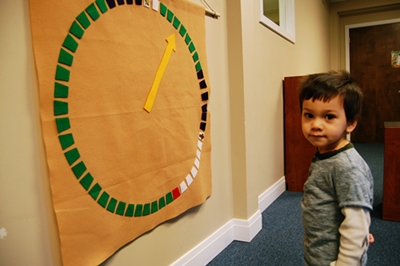
When you step into one of the children’s ministry rooms at our church you’ll see a large wall-hanging, prominent in the space. It looks like a clock but there is only one hand. In place of numbers and minute-marks are blocks of varied colors: purple, white, green and red.

There are more green blocks than any other and only one red block. The purple and white blocks always adjoin each other and there is a curious sequence of white blocks that feels to me like attention-getting laughter, unstoppable and overflowing.

It is definitely a clock but…what kind of clock could this be? Some people call it the “church clock” but I prefer to call it a Sabbath clock. Here’s why: it tells time by days of rest.

The children are both fascinated and frustrated by this clock. Each week they get to move the hand one block, but that is all. Time on this clock does not move very quickly. In fact, it is downright slow! Some children have made their peace with that while others invariably want to move the hand 4, 5 and sometimes 12 spaces at a time. I suppose adults are that way, too.

The Sabbath clock is a patient clock. Mostly, it is patient with people who are impatient. Never mind, try as we might to speed up what the clock wants to form in us, she will not be rushed. We can try to move the hand more, but that will not change what color marks the day. The Sabbath clock is always true, never too fast and never too slow. We do not control her; she is like the sun that way.

The Sabbath clock tells a story we’re in but it is not primarily our story. It is the story of God-with-us. It is the story of a surprise guest named Jesus. We waited and waited and waited for this guest until it seemed like we were waiting for Godot, the visitor that never comes. The surprise is that when God came, he came as a big God in the disguise of a little God. Jesus is the Godot that shows up at the end to make a new beginning. The story of Jesus starts small, as small as a baby—small, but new.

The story of the Sabbath clock goes on to include celebration, revelation, and Pentecost—both immanence and transcendence.

In a word, the story of Jesus is a Sabbath story. This clock tells a new creation story. That is why Christians changed the day of observing Sabbath from the seventh day to the first day of the week.  Something new happened and happens on that first day of the week. What was dead rises. What is dead rises. What was renews to become what is and is to come. That is why the Sabbath clock marks time differently. It is a clock of past, present and future. We will never be able to tell time outside this clock. In fact, strictly speaking, it is a clock that does not even tell time—it tells eternity, which is beyond time.

Yet somehow we meet this eternity in our time and place, like Christmas. We meet Sabbath in the here and now but, properly speaking, Sabbath is more a place in time than a time in place.

I like this Sabbath clock because it reminds me that God is God and I am not. It reminds me of things that are beyond my control. It reminds me of a story in which I’m swept up, in which we’re all gathered like children in a full-circle hug. 

I like this clock because it reminds me to slow down. I do not need to be in a hurry, because…God is not limited by what I can accomplish in a work-week. God’s work is restful. God’s work is Rest.

I wonder if you’d like a clock like this in your home? I wonder if you know…it’s already there, whether you realize it or not. Look for it. The Sabbath clock might be hiding in a closet somewhere, silently smiling, full-faced, waiting to be found. 

Sunday, September 21, 2014

no more burdens?

Jesus came to lift burdens from the weary and oppressed, yet the church as we know it has become a place of added burden to so many people.

What has become of us? We are preoccupied with our own survival. In self-preservation mode, the church shares with others only as much as will ensure the church’s own survival. The rest is held back.

But Jesus came to offer rest and he held nothing back for himself.

May the family of Jesus grow to resemble him more and more. May the church of today learn to offer true rest and hold nothing back, absolutely nothing.

Lord, forgive us for adding burdens on those who are weary and oppressed. May our only offering be life, fullness of life.

Amen.

Sunday, August 24, 2014

quit. stop. take a break.

Sabbath is that special time when we come to the end of ourselves. It is a time when we realize we are not the master of our own fate. We are limited, finite, contingent. We cannot make a perfect world. We cannot acquire the perfect life. We are dependent on something outside ourselves. So, God invites us to enter into a place where we give all our doing—including all our attempts to make things just right—a rest.

That is what the word Sabbath literally means: quit, stop, take a break. The paradox of Sabbath is that we do not practice it by more doing; we only experience it by not doing. That is a hard truth for modern day American Christians to apply.

Sabbath is not something that we master by tweaking the way we hold church services. You don’t get Sabbath by having a perfectly decorated sanctuary space. You don’t get it by sermons that are just the right length. You don’t get it by a band of musicians playing a balanced complement of instruments, mixed well by a sound technician.

Sabbath is not something we practice by doing better at our usual doings. It is the time when we come to admit the futility of our usual doings, a time for being still to let God show us that God is God and we are not. Sabbath says, “You don’t meet me by more doing. I am only met by being received.”

Sabbath is like grace which Frederick Buechner describes as saying,

There is nothing you have to do.

God desires that each person would have a unique, personal experience of Sabbath. Sabbath cannot be received by insisting that the world conform to our liking. Sabbath says, “Just give it a rest. Reality will not be refashioned in your image.”

So, the beauty of Sabbath is that she meets us in our uniqueness. That is why Sabbath for you may be different than Sabbath for me. We do not all receive Sabbath the same way. And that is okay. The question that’s put before each of us is: “How does Sabbath appear to me?” That is a question I cannot answer for you and it is a question you cannot answer for me. If you don’t find her in the same place I find her, where do you encounter her? My hope is that each of us will have a sense of where and how we meet Sabbath.  

Sabbath reminds us that there is a God who made all things so wonderful that even his making was restful. Because God is the maker and we are those whom God made, we are dependent on him. Sabbath is that special time when we come to the end of ourselves. What do you need to lay down to rest?


Sunday, June 1, 2014

what we find in rest

Jesus only had hard words for those who had hard words…whose hearts were harder to till than a field of clay…whose work was to add burdens to souls looking for rest.

There are people today who are lonely, who are in search of friends. There is the man who is worried and the woman who doubts. Jesus was the rabbi people like this followed because he promised that if they came to him he would give them rest. He was unlike the other teachers whose commentary created lists to keep.

Jesus only has one thing on his list: “Come to me.” He only has one burden on his heart: rest.

True, it is only one thing...but in his rest we discover so much more: freedom, grace, joy, friendship and strength. He gives nothing less than a new lease on life. Wonder of wonders.  


Sunday, January 12, 2014

choosing rest

There will always be more to do. That much is certain. Rest is a choice, a trusting choice. I must trust that, should I stop doing, my life will not come crashing down.  I am not compelled to perform that task that just popped into my head—nor all the others that occupy my mind like insistent soldiers storming a battlefront.

Just rest. Let go of the trigger, shooting from one activity to the next, rapid-fire and automatic. Once you start going and doing, it’s hard to stop.

Why rest? Why stop?

Rest is a humbling choice. It has no reputation to uphold. To truly rest is to set aside one’s ego.  It reminds me I am not all that important. I can stop doing and others will go on being happy, accomplishments will be completed without me. Rest puts me in my place. I am limited.

“But…” (and here I fill in the blank) “…such and such won’t get done unless I do it now.”

“So?” she asks.

Her simple question teaches me that the many things I think are important…really are not that important. I can leave them undone and no one, myself included, will be the worse for it.

There are more reasons to rest, to be sure. For now, I’m certainly not going to analyze the issue to death.

I’ll rest.   You can, too.


Sunday, September 29, 2013

how to find rest

At that time Jesus said, “I praise you, Father, Lord of heaven and earth, because you have hidden these things from the wise and learned, and revealed them to little children. Yes, Father, for this is what you were pleased to do.

“Come to me, all you who are weary and burdened, and I will give you rest. Take my yoke upon you and learn from me, for I am gentle and humble in heart, and you will find rest for your souls. For my yoke is easy and my burden is light.” (Matthew 11:25-26, 28-30)

These words are water to a thirsty heart. Everyone, young or old, rich or poor, weak or strong, has a burden. And Jesus says ‘Come, and I will give you rest’. Those who draw near to Jesus discover that neither age, nor position, nor privilege determine ultimate status. In the company of Jesus all are simply “the weary, the burdened”.   Yes, everyone is the same here, even in our many differences.

So, in this ‘coming to Jesus’ we find solidarity. We are not alone anymore. This is so because the person we come to is gentle and humble. This is so because in his gentleness he offers rest to all. This is so because he takes away all heavy burdens. What an offer he makes!

And how do we accept it? By being a child. The wise will not accept it. They are too clever, supposedly. The learned will not accept it. They are too busy reading their books so they can talk about the latest ideas. Only children will see the offer, hear it and accept it. If they think about it, they will only do so long enough to see almost instantly that anyone who rejects such an offer has to be an imbecile. Who would reject it? No one in their right mind.

But, how do we know if the offer is real, valid? “You’ll only know if you try it,” says the child. Something tells me it’s a safe bet.

And what’s to lose? If it’s all a sham, you’ll be no worse off than you are now: burdened and weary. But, if it’s all true…well, then…you’ll find rest, rest, never-ending rest.

Happy Sabbath, friends! Here’s to rest. Here’s to the faith of a child.


Sunday, September 22, 2013

there is nothing you can do

I do not know why but I find myself in this second half of life thinking a lot about Sabbath. I have an inkling this is normal. I suppose we don’t put much stock in Sabbath until we have seen enough and done enough to learn that our incessant seeing and doing does not get us all that far.

When we start to learn this, we think: “Well, maybe if I took a break, I’d be able to get farther and do more in the long-run.” So, we start practicing rest for utilitarian reasons. We think that rest will help us accomplish more.

I suppose that is a step in the right direction. But that’s more like marrying someone because you’re in love with the idea of love without actually loving the other Person. We want what “being in love” will get us without the scandal of “being loved”. One experiences the first type as a state of control while the second case is something that lies beyond one’s control.

Sabbath is not something we can manipulate. “If I do this, she will do that.” The ancients personified Sabbath for this reason. They called her Queen Sabbath—and she will not be controlled. But, she is good. Under her rule, we live in love—a love that is granted by divine fiat, not earned—just because the King that comes with her is himself love.

By its own virtue and character such a sovereign act reminds us: “There is nothing you can do to earn this love. There is nothing you can do to earn this love. There is nothing you can do to earn this love.”*

The only way to cherish, honor and love Sabbath is to stop “doing” in heart, mind and body. As soon as we start “doing” we stop loving her.

This is the hardest thing I have ever had to do. (See? I still can’t escape that word “do”!)

I do know one thing, though: if practicing Sabbath is something we do, it is more like play—for in play we rest while doing.


(*The words in the quote above are adapted from Frederick Buechner)

Saturday, August 17, 2013

two words

--for Heather on our anniversary

It is a beautiful Friday morning. As I walk the dog, I pass a short, thin man with a long, full beard who smiles at me and says, “Good morning.” He is wearing all black, save for a plain white collar shirt under his blazer. Atop his head: a large, broad-brimmed hat.

And there are two other splashes of white, swinging freely just below the hem on the left and right sides of his blazer: tassels.

Almost every Friday now, I pass my friendly Jewish neighbor on this stretch of sidewalk just one street over from our home. He and his family are new to the neighborhood and I find myself looking forward to his greeting every week.

He seems joyful to me. After I pass him, I wonder if he feels especially joyful today because at sunset he will say Kiddush and begin the Sabbath.

Even though it is still early, I find myself wishing him Shabbat shalom. And as I turn that phrase over in my heart, I find myself thinking of you.

.................................

I invite you to read the rest of this post over at PlayFull...

Monday, July 29, 2013

work and rest

"I wonder what the best present you ever got is?"

Both young and old looked at me and looked around and searched their minds. A child raised her hand:

"Life."

"Yes, that is a pretty good gift, isn't it? Anyone have something to top that?" I asked.

No, I don't think so. We laughed.

"Sometimes gifts are so big and so special, we don't even realize they are there. So, we have to go back to the beginning to remember them."

That's what we did yesterday. We went back to the beginning: we wondered about the creation story together.

To read the rest of the story, head over to PlayFull...

Friday, June 14, 2013

rest a while

“Rest a while.”

I can’t.

“Why?”

I don’t know. I just can’t. I have too much to do.

“Too much what?”

Everything. Work.

“You’ve never been frazzled this much about work before. What’s this about really?”

Well, really…this is about forcing things. I was…decisive. Too decisive.

“What do you mean?”

You already know what that means.

“Tell me anyway. I want to see if you know what it means: too decisive.”

I’m a…leader, see.  People look to me for answers.

“Do they?”

Well, I think they do.

“Go on.”

People look to me for answers. ‘What should we do now?’

“Okay.”

And I know what to do.

“You do?”

Yes. I can see it. I can even see answers for which no questions are being asked. But I believe the question should be asked so I give the answers ahead of time.

“Is that a problem?”

I don’t think it is at the time. And I suppose that is the problem.

“So, just rest. You need to rest. Stop. Sabbath is a verb—a beautiful verb that trumps all other verbs. I know, because I am the Word and I never speak without the bookends of silence. Learn from me. Stop. I’m able to give answers in good time.”

Yes, but--

"Shhh...It's okay. It's going to be okay. Shhh..."


Sunday, May 5, 2013

to move only by being moved upon


Why is it so hard to stop? Hard on the heels of stillness, at least eleven to-dos begin to crowd my mind and heart.

“I should do this.”

“Oh, we need to do that.”

“I hope we can go there.”

It is Sabbath morning and the branches out front have learned to sway almost imperceptibly. The only reason I notice the slight movement of a long tree limb is because I take slow-time to look. I reflect, “The branch moves that way only because of the wind. Without the breeze, that branch would be perfectly still.”

To move only by being moved upon—that is Sabbath.

Spirit, today—at least for one day—I wish only to move if you move me. Otherwise, let me be content to simply remain rooted in creation and her Father, who created rest. 


Monday, November 5, 2012

Sabbath fragments


Mark well the pattern of creation.  As an end, the Sabbath rest represents the pinnacle. Notice that we do not rest one day so we may work six days. It is the other way around: we work six days so we may rest One day. Jesus confirms this truth: “The Sabbath is made for people, not people for the Sabbath.”

God wants to give us rest. He himself is our Sabbath rest.

The writer of Hebrews speaks of Jesus as our once-and-for-all priest and our once-and-for-all sacrifice. Why do we tend to leave out that he is also our once-and-for-all Sabbath rest?

Jesus himself invites us: “Come to me, all you who are weary and burdened, and I will give you rest.”

Notice that rest is a gift for which we may not work. As soon as we feel we have to earn it, we have stopped resting.

Yes, rest is granted. Our only part is to receive it and enter into it—or allow it to enter us. It seems too good to be true.

“What did you say he wants to give us?”

“Rest. That is all. Just rest.”

“That is all? But…”

“It seems so simple, I know. How can it be?”

“Yes, how can it be?”

“But it is, it is.”

I can hear the sighs of relief even now as this undeserved blessing sinks in to our souls. What a relief!

…………………..

We live in a restless world. Restlessness insinuates itself into too many relationships. Our need to acquire material possessions creates restlessness. And our self-protective postures are bound up in restlessness.

St. Augustine was right: “Our hearts are restless until they find their rest in You, God.”

The Psalmist knew this long before then: “Be still and know that I am God.”

When will we learn to rest, just rest?

……………………………….

On day five, God said his creation was good and he blessed it.

On day six, God said his creation was very good and he blessed it.

But day seven was even better: God made it holy.

Abraham Joshua Heschel points out that the Hebrew expression which we translate as “made holy” can also be translated as “married.” To make something holy is to marry it—to set it apart and cherish it and cling to it all at once.

For this reason, the Sabbath is often portrayed in Jewish literature in feminine terms. She is to be received as a bride.  She is addressed as Queen Sabbath in the special day’s opening prayers and appropriately mourned in closing prayers.  Her spirit thus infuses the other six days of the week, until a reunion can be enjoyed come next week. Sabbath thus represents both the origin and culmination of life.  In many ways, she is the personification of shalom: no peace exists without Sabbath and Sabbath always brings peace.

…………………..

“So, what does this have to do with me?”

Well…some of us need to simply let ourselves be loved by King Jesus because Queen Sabbath always attends him.

Others may need to simply learn the ways of Queen Sabbath for, in doing so, we grow more in love with the Lord Jesus.

In either case, my prayer is that each of us would learn to rest in the God who wants to give us rest, and that God would enable us to help others find the rest they so desperately need in a restless world.

Friday, April 13, 2012

sabbath as destiny

If you want to recover a sense of Sabbath in your life, I highly recommend reading The Sabbath by Abraham Joshua Heschel. Here’s something that stuck with me when I had the joy of reading it recently.

In the biblical creation account we come across an interesting juxtaposition. God creates light and sees that it is good. God creates the sea, the land and plants. He sees that all this, too, is good. He creates the sun, moon and stars—and sees that they are good. Notice what happens next:

He creates the creatures of the sea and sky. He sees that they are good. And he blesses them.

The first blessing.

On the sixth day, he creates the creatures of the land--both animals and humans. He sees that they are good. And he blesses them, too.

The second blessing.

He views all his handiwork and says of it all, “It is very good.”

Then, the seventh day comes.

And he creates rest. A whole new kind of creation. We tend to think of rest as the cessation of creation, but here we see that rest represents the pinnacle of creation.

And—notice!--God blesses the seventh day. And makes it holy.

The progression:
Good,
Good,
Good,
Good and blessed,
Good and blessed,
All of this is very good. But, the seventh day is even better; the seventh day is—notice!--
Good and blessed and (the text says) set apart as holy.

You will notice that the first two blessings are for the movers and workers (days five and six) in the space that God created (days one through four) but the final blessing is for time—a day!

It is a pity the seventh day appears in our Bibles as the beginning of chapter two instead of the end of chapter one because lyrically speaking the seventh day represents the climax of the text--not the sixth day as we often suppose.

Though all that God made is set apart as holy, in the text our attention is drawn to the seventh day--for this aspect of creation alone is especially named as holy.

The words “made holy” may also be rendered “sanctified”. Heschel points out that in Hebrew to be “sanctified” is to be “married.” The two English words are one and the same in Hebrew.

The picture here is of a groom (all of creation) meeting his bride (Bride Sabbath) for which we were all made.

We see here that we do not meet this Bride in a particular space as much as we do in a particular time, because the Sabbath is not bound to a place. Rather, she approaches us via time. In short, Sabbath is holy time. And, like a Bride, the Sabbath yearns for her groom to consummate the marriage of space in time.

Viewing Sabbath as our destiny means we do not rest one day so we may work six days; rather, we work six days so we may rest one day. Our work should be directed towards (and flow out of) the rest of God because we were made for this kind of rest.

The New Testament tells us that, in Jesus, we are able to enter into eternal rest. In Christ, the rest of one day, becomes the rest of One Day (eternity). The space in which we move (that was made the first four days) and the work we pursue (along with all living things made on days five and six) point to a rest in time--and, ultimately, in eternity (as specified on day seven).

So much of our modern world tries to negate the fullness of Sabbath! We work to become masters of space, to subdue the world around us. We view this work as our teleos. We have even extended our desire to subjugate space to encompass the subjugation of our fellow creatures. Either way, all our energies are directed towards subduing things and places.

But the Sabbath woos us—she would subdue us with love and restful acceptance of her gifts. She says, “Come away to my palace in time. Here there is no need to subdue. Here--in this soul-space--blessed desire is awakened and finds its fulfillment. Come away and feast. Come away and celebrate. Come away and kiss Eternity who comes in time. You do not need to produce incessantly as you suppose.”

Here, in this palace in time, we discover our true selves and our God-who-is-love; Sabbath is a Queen and wedding ourselves to her makes us heirs of an eternal kingdom.

May we truly hear Jesus’ words to us as an invitation to Sabbath when he says, “Come to me all you who are weary and I will give you rest.” Let his words sink in: Rest is what he wants to give us. Let us receive it.

Tuesday, August 2, 2011

learning from finches

It is not wise to keep producing, producing, producing as if we have no limits and need no rest.

It is a pity that both the world-system and the religious systems we have constructed reinforce this practice of incessant output: Retail has turned into a 24/7 enterprise. The book title “Always On” speaks for itself. If you require further explanation, consider its subtitle: “How the iPhone Unlocked the Anything-Anytime-Anywhere Future--and Locked Us In.”

A prominent religious leader has published a book recently: “Your Best Life Now.” Before and after reading this “can-do” book we do well to contemplate what we cannot do. God’s grace always picks up where we leave off so let us let go of our reluctance to let go. Let us see the value of rest.

Our souls cannot bear the weight of “Do! Do! Do!” God even wishes the land on which we live a sabbath rest. He designed a Sabbath of Sabbaths. It is fitting that slaves are liberated on such an occasion. Let us see in our compulsion to perform-without-letup a form of slavery. If we have eyes to see this, why do we not lay hold of God’s proclaimed liberation as a true and lasting jubilee? Busyness is a disease that kills. If the enemy would destroy us, he need only keep us working.

We in the business of religion like our meetings in which we like to discuss (what we feel are) “pressing issues”. Lately, I have discovered that I ask myself afterwards: “To what end? Why do we concern ourselves with half these matters? Would it not be wiser to leave off our talking overmuch and turn these discussions into occasion for simple prayer, which is a way to rest in God? And why do I become anxious when we are discussing ‘burning issues’ when very little of what we discuss is truly ‘burning’? Learning to love God and love others, learning to make disciples, growing in our attachment to God—these are the things that really matter. How much busy discussion should this require? Why do churches and church leaders too often quibble over words and strategies? Is this not what the world system does in its tautological marketing?”

We become anxious because we must keep producing and we must keep producing otherwise we may become plagued with anxiety. In this way, anxiety and production go hand-in-hand. They are parasitic, co-dependent. We feel people demand some kind of production, that they need some kind of tangible product from us—but people do not need our ministries, they need God--and many of our ministries (let’s face it) try to serve as a substitute for God.

Let us give these games a rest. The only way out of the cycle of work-anxiety is the practice of rest, which requires the exercise of trust. So, let us trust that we can rest and the world will not disappear. Let us remember that we were designed to work, rest and play in proportion even as birds know how to gather, sleep and sing by nature. Let us recollect these instincts that enable us to truly fly free.